|
Portugal's
Alentejo
Part
2: Herdade da
Malhadinha Nova
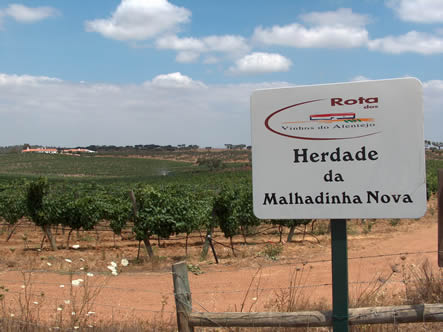 When
I was making plans to visit the Alentejo, I asked Dirk Niepoort if
there’s anyone he thought I should visit besides the obvious
choices. He texted back a message including the name ‘Peceguina’.
It’s the second wine of one of the Alentejo newcomers, Herdade
da Malhadinha Nova, and so a month later I found myself checking
out this new estate – I’m very glad I did. When
I was making plans to visit the Alentejo, I asked Dirk Niepoort if
there’s anyone he thought I should visit besides the obvious
choices. He texted back a message including the name ‘Peceguina’.
It’s the second wine of one of the Alentejo newcomers, Herdade
da Malhadinha Nova, and so a month later I found myself checking
out this new estate – I’m very glad I did.
I dislike hype, and I’m aware that media folks have a
tendency towards hyperbole. That said, I genuinely regard
Malhadina Nova as one of the most exciting new properties I’ve
visited, and I’m confident saying that this is perhaps the
Alentejo’s leading estate, even though they’ve only been going
since 2003, the first vintage here.
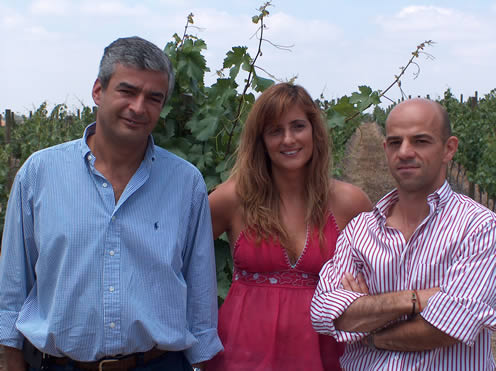
Luis Duarte, and Rita and João
Soares, pictured in their vineyard
It’s the baby of the Soares family, who own a
successful chain of wine shops (Garrafeira Soares) and a
distribution business in the Algarve. I was met by Rita and João
Soares, and consulting winemaker Luis Duarte was also on hand.
Luis spent 18 years working with David Baverstock at Esporão and
now consults for a range of properties including Quinta do Mouro
and Herdade Grande in the Alentejo. As well as 18 hectares of
vineyards, this new venture has a lovely family home (the Soares
clan use this as their weekend getaway - it's not far to the
Algarve where they work), cork oak forests populated by black
pigs, and wheat fields. The pigs deserve a special mention: they
are the breed of black pig that makes the fantastic pata negra
ham. In order to qualify for this, they must be fed solely on
acorns from the cork oaks, which necessitates a hectare of cork
forest for each pig (they're pictured below - they are black, but
covered in red dust).
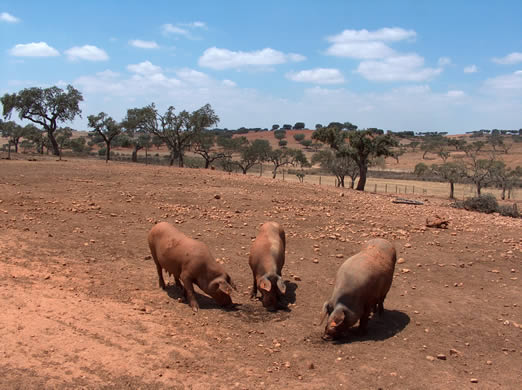
The black pigs
The focus here
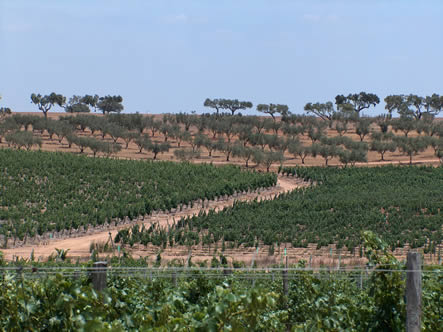
is firmly on quality. The vineyards are beautifully maintained,
and the winery is something else. It's beautifully constructed in
a gravity flow system, so pumping isn't required. At the top are
the numerous small open fermenters, and then various sizes of
tanks, finishing up with the larger blending and storage
tanks
| But
vineyards and winery aside, it's the wines that caught my
attention. They are fantastic. They're modern, but in the
best possible way, showing lovely expressive fruit that
still manages to retain a sense of place - these aren't dull
'international'-styled wines that could have come from
anywhere.
Of the 18 hectares of
vineyards, 2 are dedicated to the white varieties Antão Vaz,
Arinto, Roupeiro and Chardonnay. The red varieties grown
here are Touriga Nacional, Syrah, Cabernet Sauvignon,
Aragonês, Alicante Bouschet and Alfrocheiro. Grapes are
harvested by hand into 12 kg boxes, then sorted at the
winery. Each parcel is fermented separately after
destemming and crushing.
The
wines
Rosé de Peceguina 2004
Made initially for Algarve tourists (but it's been a
success everywhere), this is an unashamedly commercial style
- fruity, fresh and a little sweet. More-ish and accessible.
Very good 84/100
|
 |
 |
Monte de
Peceguina Branco 2004
Quite a deep yellow colour. Bright, fresh fruity nose of some
depth. The palate is quite fresh with good depth and weight. Nice
definition and good concentration; modern but good. Very
good/excellent 91/100
Malhadinha
Branco 2004
Very toasty, rich and broad on the nose. Very refined, creamy
and smooth with a nutty edge. The palate has a wonderfully rich
texture and weight. Complex and fine, this is a serious wine: it
has a rich texture and plenty of weight, combined with freshness.
Very good/excellent 93/100
Monte de
Peceguina Tinto 2004
Fantastic nose showing ripe, smooth, sweet red and black
fruits with good definition. The palate shows wonderfully defined
ripe fruit, great concentration and freshness, and good savoury
structure. Brilliant effort and a bit of a bargain at under 15
Euros. Very good/excellent 94/100
Maladinha
Tinto 2003
Super-smooth, intense, lush berry fruit nose. The palate is
intense, ripe and concentrated with lovely fruit sweetness and
structure. Dark and intense, this is accessible yet still quite
serious. The oak (12 months in new French barriques) is in check.
A new Portuguese cult wine in the making. Excellent 95/100
See also: a
more recent report (July 2011) on these wines
Back
to top
|