|
Portugal's
Alentejo
Part
7: Mouchão
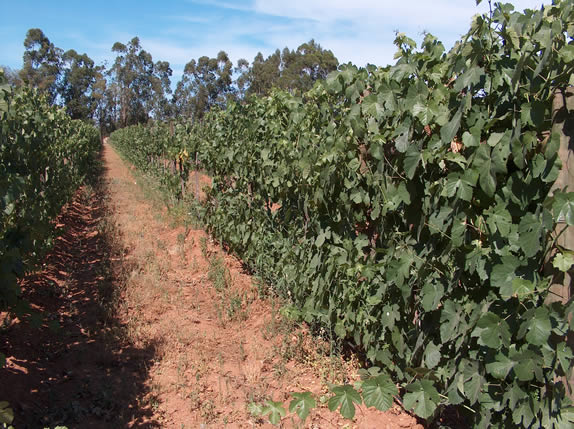
 Mouchão is a wonderful estate, but perhaps a bit of a
paradox. On the one hand, it has the most traditional winery you
can imagine; on the other, the vineyards have a fairly
elaborate modern-styled double trellising system (see picture
above). To understand this apparent paradox, we have to look at
the recent-ish history of the Herdade. Mouchão is a wonderful estate, but perhaps a bit of a
paradox. On the one hand, it has the most traditional winery you
can imagine; on the other, the vineyards have a fairly
elaborate modern-styled double trellising system (see picture
above). To understand this apparent paradox, we have to look at
the recent-ish history of the Herdade.
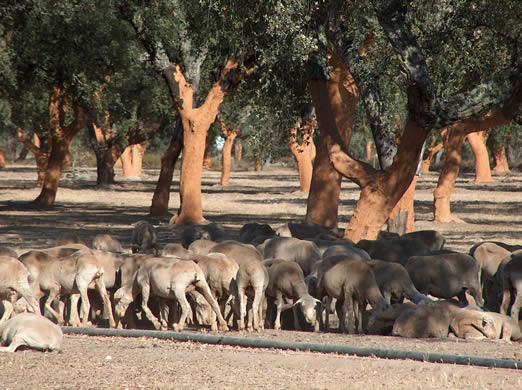
Mouchão has been owned by the Reynolds family since
the mid-19th century, when Thomas Reynolds set out south from
Porto to the Alentejo in search of a cork estate. He found Mouchão,
all 900 hectares of it. Even today the estate is mostly cork
grove, with a bit of vineyard - although its the wine that it is
known for.
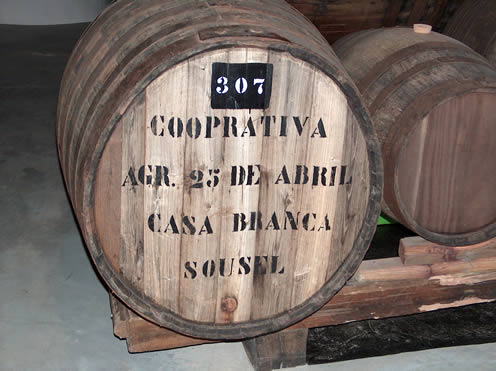 In
1974 revolution, the Alentejo region became the setting for a
rural uprising, and as part of this the Mouchão estate was taken over by the locals, who formed the 25th
April Co-operative (see the barrel, pictured right). Two things
happened: the vineyards were trashed and a lot of the wine stored
here was drunk. The property was restored to the family, who came
back in 1985/86 and started a rebuilding program. Thus the
vineyards have been completely replanted, but the winery has been
left more-or-less alone, because the quality of the wine here was
already well established. In
1974 revolution, the Alentejo region became the setting for a
rural uprising, and as part of this the Mouchão estate was taken over by the locals, who formed the 25th
April Co-operative (see the barrel, pictured right). Two things
happened: the vineyards were trashed and a lot of the wine stored
here was drunk. The property was restored to the family, who came
back in 1985/86 and started a rebuilding program. Thus the
vineyards have been completely replanted, but the winery has been
left more-or-less alone, because the quality of the wine here was
already well established.
 |
Inside the
winery: the doors open to receive the grapes, which go into
the stone lagar, where fermentation occurs with foot
treading: a gentle method of extraction. From here the wine
is pressed and racked off into large barrels (each holding a
couple of thousand litres), or the barriques shown here on
the left. |
When
the revolution occurred there were 34 hectares of vines, and the
goal is to bring the vineyard area back to this level. A
significant feature of the Herdade is the high proportion of
Alicante Bouschet grown here: the main wine has 80% of this grape.
It's what is known as a teinturier, which means that the pulp as
well as the skins is pigmented. This makes super-dark wines,
but frequently Alicante is only used as a minor blending component
because it is considered a bit rustic. Not so here.
One
interesting aside: Mouchão makes use of a novel fig tree bird
protection system: figs ripen at the same time as the grapes
presenting the birds with an easier and perhaps tastier meal, so
the grapes are spared.
 For
the main wine, after the first winter 25% of the wine goes into
new barrels, the rest into foudres. Then, at the end of the third
year, a final selection is made. Second wine Dom Rafael, which has
a lower proportion of Alicante, starts life the same way, but 50%
goes into second
use 225 litre barrels. For
the main wine, after the first winter 25% of the wine goes into
new barrels, the rest into foudres. Then, at the end of the third
year, a final selection is made. Second wine Dom Rafael, which has
a lower proportion of Alicante, starts life the same way, but 50%
goes into second
use 225 litre barrels.
The
wines are hugely impressive and ageworthy - this estate is clearly
one of the stars of the Alentejo. As well as the wines tasted
here, there's also a super-cuvee called Tonel 3 & 4, which I
didn't try on this visit, but have since managed to track down.
It's very special indeed.
Dom
Rafael Branco 2004
A blend of Arinto and Antão Vaz. This expressive, full white
has a distinctive smoky, spicy edge to the ripe melon and lemony
fruit. The palate is rich, broad and quite spicy with lovely
rich-textured fruit. Delicious and full. Very good/excellent
90/100
Dom
Rafael Tinto 2003
This is mainly Trincadeira with Alicante Bouschet and Aragonêz.
Rich, dark, full spicy nose with complex lush fruit. The palate is
savoury and dark with good depth of fruit and some nice spicy
structure. There's a lovely savoury depth here: it's not overtly
fruity. Delicious. Very good/excellent 90/100
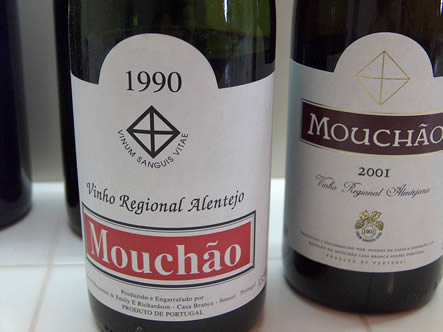
Mouchão
2001
The 100th vintage at the estate. This is a blend of 70%
Alicante with 30% Trincadeira. Very savoury, dark, intense spicy
nose with a strong savoury meaty streak. The palate is dark,
savoury and spicy with firm tannic structure and a distinctive
meaty, spicy edge. A wine with real appeal. Very good/excellent
93/100
Mouchão
1990
Wonderful open, spicy nose: evolved, earthy, savoury and
perfumed, but still showing some big sweet fruit. The palate is
evolved, spicy and ripe with rich dark fruit and a tobbacoey,
herby edge. Satisfying and rich. Still quite tannic, but drinking
very well now.
Back
to top
|