|
Visiting
New Zealand's
wine regions
Part 8: Craggy Range and Steve Smith

The
view from behind the winery/visitor centre at Craggy range,
showing the Te Mata peak
It’s hard not to be impressed by Craggy Range, which
is emerging as one of the new world’s great wineries. Every
aspect of what they do has the stamp of seriousness about it, not
least the amazing cellar door/winery/restaurant complex in
Havelock North, just under the shadow of the Te Mata peak.
However, just one wine is made here (the ‘Sophia’) in the
rather photogenic but sparse winery. Most of the winemaking is
carried out a few miles up the road in a rather less photogenic,
but more practical, industrial-looking winery.
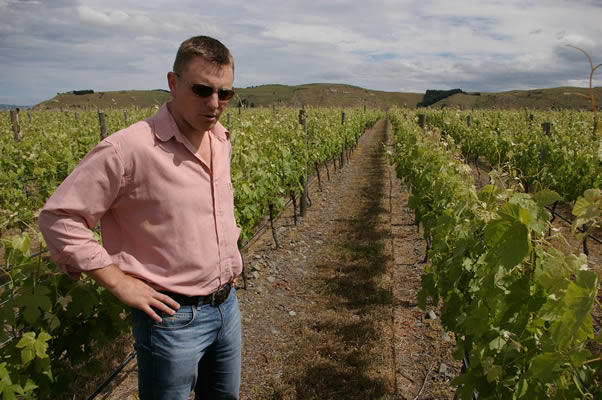
Rod
Easthope in the Gimblett Gravels Vineyard
I arrived at the latter, to be greeted by Rod Easthope,
one of the two senior winemakers. Rod’s responsibility is Syrah,
Bordeaux reds, Chardonnay, Pinot Gris and Viognier. His
counterpart Adrian Baker is in charge of Riesling, Sauvignon Blanc
and Pinot Noir. In overall command operations is Steve Smith MW,
who is joint MD of Craggy Range and a partner in the business.
Steve was busy with a board meeting for Pinot Noir 2010 which was
being held at Craggy, but I was to catch up with him and the other
board members for their dinner that evening, which I was kindly
invited to crash, as well as joining him for breakfast the
following day.
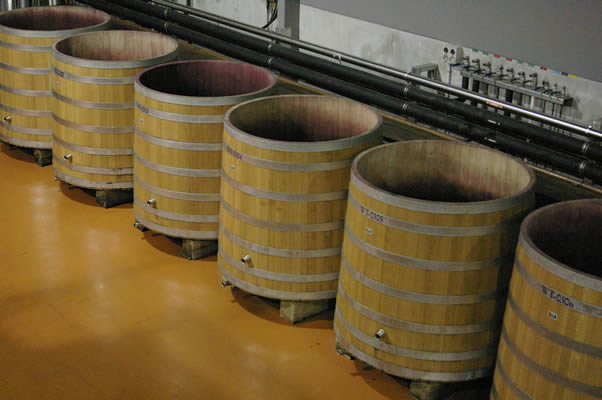
Small
open-top fermenters in the winery
I visited the Gimblett Gravels vineyards with Rod, and
then we looked at the winery, which is set up to deal with small
batches. Craggy are unusual in that they are a reasonably big
operation, but they focus almost entirely on making relatively
small runs of high-end, single vineyard wines, with grapes from
several carefully chosen vineyards across most of New Zealand’s
key winegrowing areas. There are no ‘entry level’ Craggy
wines, although there is a quite separate brand, Wild Rock, which
is devoted to more affordable, but still quite high-end wines.
It’s a smart strategy keeping the two separate: it means that
the Craggy branding isn’t diminished by more commercial wines;
it also means that should Craggy ever want to, they can sell Wild
Rock as a separate entity.

Steve Smith MW, MD of Craggy Range
We then did a fairly extensive tasting, focusing on
Craggy’s Rieslings, Pinot Noirs, Syrahs and Bordeaux Blends. In
my tasting notes (which will be published in a couple of days as a
separate article) I also include some notes taken at a couple of
other recent tastings, bringing in Chardonnay and Sauvignon Blanc.
My verdict? Quality is amazingly high, almost across the board.
How do they manage this? ‘People say it’s because we have the
money’, says Steve Smith. ‘It’s not. You can do what we do
in the vineyard and the winery even if you only choose to do it on
a single acre.’
Referring to the approach of concentrating just on
relatively small volumes of many single vineyard wines, Smith adds
that, ‘We’re lucky, in a way, in that we do have the
opportunity to develop a market for these wines, whereas it’s
harder for the little guys’.
Perhaps what leaps out of tasting through these wines
is the quality of the reds, not traditionally New Zealand’s
strong point. It has been an important mission for Craggy to show
that New Zealand isn’t just about white wines. ‘If you are
going to be a great wine nation you have to show that you are
great at producing reds’, says Smith. He reckons that New
Zealand has three opportunities to produce great red wines. First,
with Pinot Noir, then Syrah, then Merlot/Cabernet Franc blends.
The latter he sees coming from the Gimblett Gravels only, and
while Syrah performs well in the gravels, it is more forgiving of
cooler areas than the Bordeaux varieties.
‘I would love to come to the UK with a dozen New
Zealand reds’, says Smith, anxious to tell the world of what is
going on here. But he hasn’t always been such a fan. ‘I’ve
had to be convinced by New Zealand reds’, he admits, ‘Ten
years ago there were some good wines and a hint of greatness from
a few. Five years ago I began to take more notice. Then all of a
sudden there was a hint balance and beauty in the wines. From
2003–2006 there was the most remarkable improvement in quality
of any wine style in the world.’ The Craggy Bordeaux blends,
Syrahs and Pinot Noirs are superbly good, although I wouldn't want
to see them drift any further along the ripeness spectrum, perhaps
losing their definition and freshness.
There is one grape variety where Craggy have come in
for some criticism, and that’s with their Sauvignon Blanc. ‘In
big tastings the Craggys hardly ever get medals’, says Smith.
‘They have textural components and are not so enamouring on the
nose, and the textural component is the thing that gets overlooked
when people are assessing wines.’ He’s frustrated that just
one style of Sauvignon gets all the attention. ‘Many gatekeepers
show a preference for a single style of Sauvignon Blanc, which is
not a true reflection of what New Zealand can do’. This style is
the intensely ripe style, with lots of passion fruit and
gooseberry. ‘New Zealand is not a simple place’, says Steve.
‘It’s the world’s youngest place and you never know what to
expect around the corner. So why do we have a monotone of
Sauvignon Blanc style?’ He thinks there are at least three other
legitimate Sauvignon Blanc styles: the fine nettly version, the
beautiful lime and flowers style with minerality, and the softer
talcum powder textured style.
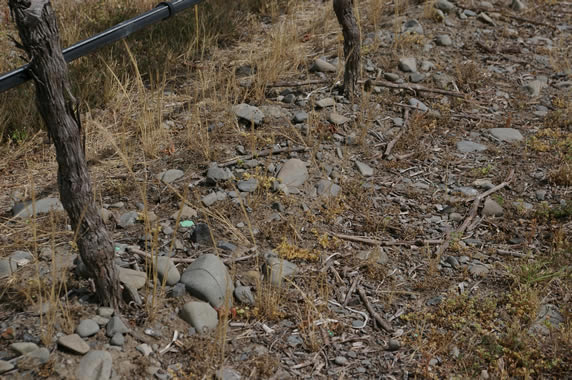
Smith tells me of an innovation in the Gimblett Gravel
vineyard that he’s particularly pleased by. He’s been thinking
about the gravelly soils in Bordeaux, and the way they aren’t
uniform in colour, with darker shades that warm up the soil, and
then some quartz like elements that reflect light back up into the
canopy. ‘Dark heat and reflective light is a special quality of
Bordeaux soils’, he says. The Gimblett soils (above) are all
grey and don’t reflect much, although they do warm up nicely.
The benefit of reflecting light into the canopy is that it aids
phenolic ripening, so that the grapes are fully ripe at lower
potential alcohol levels. For this reason Smith considered using
artificial reflective cloth under the vines, but this has the
potential to cool the soils down and is also a rather artificial
way to maintain the environment. So instead he adopted an idea
that he’d seen used by Tim Finn at Neudorf, who used mussel
shells as a white mulch over a Pinot Noir vineyard. Smith obtained
oyster shells, a waste product from an oyster farm, and crushed
them before applying them to the vineyard, to cover half the
surface area. The reflected light had an impact on the wines, and
in particular in making the tannins more velvety. The shells are
also full of calcium, which should help balance the potassium in
the soil which is released by irrigation. This project has now
been extended to cover 8 hectares.
We turn to more general issues concerning the New
Zealand wine industry as a whole. One concern about viticulture in
New Zealand is how long the vines will last. ‘The biggest issue
is leaf roll virus, which is a major problem in our vineyards,’
says Smith. ‘As Sauvignon Blanc vines hit 15 years old (when you
get serious texture in the wines) it’s starting to affect
them.’ This virus remains latent for 5–10 years, and is spread
by a sap-sucking insect called the mealy bug. In recent years
mealy bugs have spread as far south as Hawkes Bay. The ants
prevalent in stony soils and these ants farm the mealy bugs,
feeding on the honey dew they secrete.
‘As a country, New Zealand should be viewed as the
boutique farmers of the world, because of our size and
remoteness.’ Smith adds that a cornerstone of winegrowing in New
Zealand is sustainablility, because ‘we need to be good
custodians of the land’. He cites four management KPIs for New
Zealand growers:
(1) Nil residue wines (this is most important for
people interested in organics); (2) improving soil health by not
using residual herbicides (interestingly, he says he’s heard
that it’s possible for mycorrhizae to absorb glyphosate and pass
this on to the plant); (3) reduced hydrocarbon use; and (4) better
wine.
‘New Zealand realistically could be the first carbon
neutral wine industry in the world’, claims Smith. ‘There are
smart ways that carbon dioxide production can be offset. It should
be done because it is right for us: it allows us to have a better
business.’ He also thinks that the definition of
‘sustainable’ could be improved. ‘To be audited sustainable
there are things that you cannot do, but there is no difference
between those who score low and high on the scale’, says Smith.
He suggests that way forward might be to have, for example,
‘pure silver’ and ‘pure gold’ levels of accreditation for
wineries that have journeyed further on the road of
sustainability.
Finally, Smith lists three things that New Zealand can
own.
(1)
It
can be the best producer of aromatic white varieties in the New
World, and here he includes Sauvignon Blanc with the likes of
Pinot Gris and Gewürztraminer.
(2)
It
can be the best New World Pinot Noir producer.
(3)
It
can be the only home of rich yet finely tuned red wines.
It’s a brave vision, but when you see what producers
like Craggy Range are achieving, such a vision looks even
probable.
To
come: Tasting notes of Craggy Range's wines
Back
to top
|