|
Brian
Croser,
Petaluma and Tapanappa
 I
don't think Brian Croser needs much of an introduction. One of the
most famous figures in the wine world, he rose to prominence in
the mid 1970s, when he left his position as chief winemaker with
Hardys to begin the celebrated wine science course at Riverina
College in New South Wales. At this time he also founded an
influential wine consultancy and his own winery, Petaluma. I
don't think Brian Croser needs much of an introduction. One of the
most famous figures in the wine world, he rose to prominence in
the mid 1970s, when he left his position as chief winemaker with
Hardys to begin the celebrated wine science course at Riverina
College in New South Wales. At this time he also founded an
influential wine consultancy and his own winery, Petaluma.
I was fortunate to spend two days with him at the end of
September last year (2005), at his home in the Adelaide hills
(next door to the Petaluma winery and the famed Tiers
vineyard).
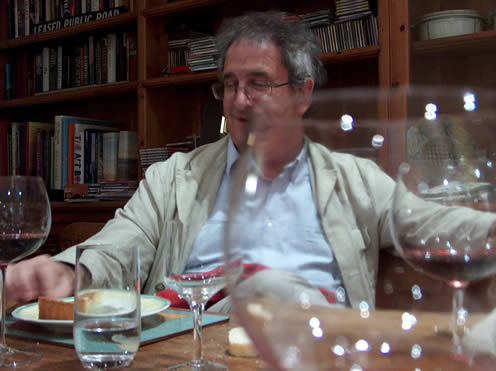
We began with dinner on the Friday night. The Croser
household had a bubbly air to it. As well as a strong
representation from Brian’s family (he's pictured here with his
wife Ann), influential French critic Michel Bettane was over; he’d
been a guest judge at the Adelaide show. This was good news for
me, because it meant Brian had a strong incentive to dig deep into
his cellar (Bettane himself is a total wine nut who has many
thousands of bottles stashed away; like Robert Parker, Bettane
made his reputation with the 1982 Bordeaux vintage, and the two are good 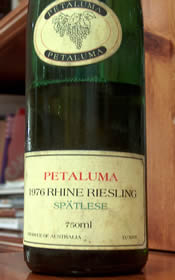 friends).
In a fun gesture, Brian had raised both the French and British
flags on two poles outside his house in recognition of his
international guests! friends).
In a fun gesture, Brian had raised both the French and British
flags on two poles outside his house in recognition of his
international guests!
We began dinner with a historical wine: Petaluma
Riesling Spätlese 1976 from a vineyard in the Clare. This was the
first wine Brian made under the Petaluma label, and this
particular bottle was the last one left. In the 1970s the modern
Australian wine industry was in its infancy. Chardonnay was almost
unheard of at this stage. So this wine is a bit of history.
Petaluma Rhine Riesling Spätlese 1976 Clare
Very deep yellow/orange colour. Unusual savoury nose with some
waxy, herby notes. Savoury palate is chunky and savoury with some
complex herby notes. Hard to rate – certainly quite interesting.
 Croser
was at the time lecturing at Wagga Wagga in New South Wales (Riverina
College of Advanced Education, now Charles Sturt University),
along with Dr Tony Jordan (now heading up Domaine Chandon, Cape
Mentelle and Cloudy Bay for LVMH). He started the wine science
course here, and went on to establish an influential winemaking
consultancy, Oenotec, along with Jordan. One of his contributions
to the industry at the time was that he advocated the use of
reductive wine making. By the use of stainless steel, inert gases
and temperature control, the idea was to preserve fruit flavours
in wine by protecting the must and evolving wine from oxygen
exposure, especially important for making fresh whites. This is
one of the reasons for the success of the Australian wine industry
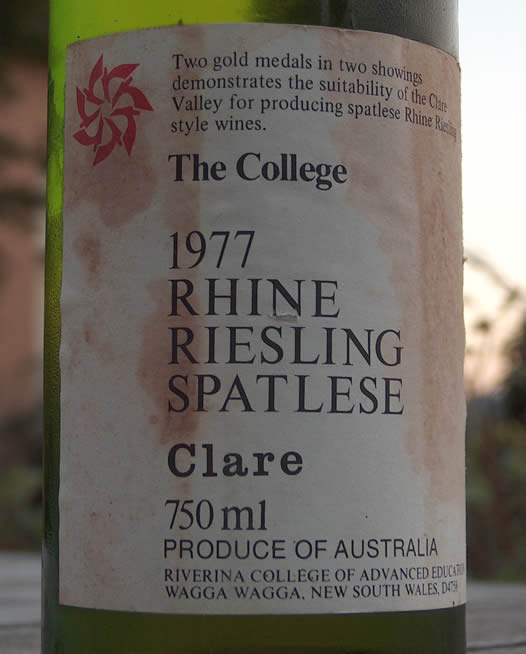
in the 1980s and 1990s. I've tried a couple of the wines made in
the Riverina College cellars from the late 1970s, and they've
held up well (pictured right is a 1977 Clare Rhine Riesling tasted
in March 2006 - the text looks Croser-like, and I'm guessing that
the grape source for this wine is the same as that of the 1976
Petaluma wine mentioned above). Croser
was at the time lecturing at Wagga Wagga in New South Wales (Riverina
College of Advanced Education, now Charles Sturt University),
along with Dr Tony Jordan (now heading up Domaine Chandon, Cape
Mentelle and Cloudy Bay for LVMH). He started the wine science
course here, and went on to establish an influential winemaking
consultancy, Oenotec, along with Jordan. One of his contributions
to the industry at the time was that he advocated the use of
reductive wine making. By the use of stainless steel, inert gases
and temperature control, the idea was to preserve fruit flavours
in wine by protecting the must and evolving wine from oxygen
exposure, especially important for making fresh whites. This is
one of the reasons for the success of the Australian wine industry
in the 1980s and 1990s. I've tried a couple of the wines made in
the Riverina College cellars from the late 1970s, and they've
held up well (pictured right is a 1977 Clare Rhine Riesling tasted
in March 2006 - the text looks Croser-like, and I'm guessing that
the grape source for this wine is the same as that of the 1976
Petaluma wine mentioned above).
Michel Bettane
The second wine was met with a touch of disappointment:
it was very fine, but more had been expected of it.
Drouhin
‘Marquis de Laguiche’ Montrachet 1996 Burgundy
Really fantastic nose: toasty and minerally; full and rich,
with plenty of complexity. Dense, savoury, mineralic palate with
good acidity. Not great, but a very smart white Burgundy. Very
good/excellent 94/100
Petaluma
This is probably a good time to recount the Petaluma
story. Petaluma was Brian’s baby, and although I don’t dare to
press, I get the impression that the hostile takeover by Lion
Nathan in 2001 is still a source of deep regret to him. Yes, he
stayed on as the figurehead of the group until last year (his last
responsibility was finishing off the 2005s), but Petaluma was no
longer his, and while he’s now a relatively wealthy man (it’s
rude to ask someone about their financial details, but someone
else suggested that the Petaluma sale had netted him in the region
of A$20 million), one suspects that the money hasn’t compensated
for the disappointment and angst of losing control of one’s own
venture.
The name Petaluma came from the town in California,
where Brian had spent some time (he studied at UC Davis in the
early 1970s). The two most famous wines are the Chardonnay (from
the Piccadilly Valley; latterly there has been a separate bottling
of the Tiers Vineyard Chardonnay) and the Coonawarra
Cabernet-based red. Both are among the best of their type from
Australia. There’s also a smart Clare Riesling, and in more
recent times extra wines have been added to the portfolio. [More
on Petaluma later, including a mammoth vertical tasting.]
Tapanappa
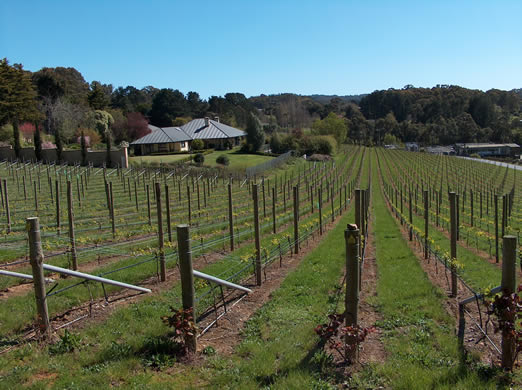
Now Brian is no longer involved with Petaluma, his
energies are focused on a new venture, called Tapanappa. The first
wine to be released is the 2003 Whalebone vineyard Cabernet
Shiraz, a seductive, smoothly fruited red of real poise. There
will be other single-vineyard wines in the stable, including a
Chardonnay from the Tiers vineyard in Piccadilly, next to Brian’s
house (below). He’s also growing Pinot Noir on the
Fleurieu Peninsula, where it’s foggy, cool and humid. Tapanappe
is a joint venture between Croser, Jean Michel Cazes and the
Bollinger family.
The Whalebone vineyard is just outside the Coonawarra
appellation, in Wrattonbully. Brian first made a wine from this
vineyard, which was then known as Koppamurra in 1980 for Geoff
Weaver, and was so impressed by it that he’s been trying to buy
the vineyard ever since. This pursuit took 22 years.
The vineyard now has 30 year old vines, with yields of
a ton an acre (15 hl/ha). The soil is 800 000 years old. There’s
a cave under the vineyard which contains the skeleton of a Eubalena
australis, the southern right whale, hence the name.
The next two reds were blind, and there was a
connection. First, the wine that led Croser to pursue this
vineyard, still looking very smart after 25 years, and then the
modern day rendition of this terroir.
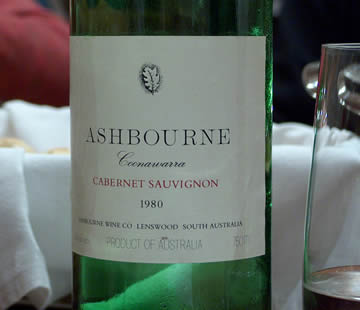 Geoff
Weaver Ashbourne Cabernet Sauvignon 1980 Coonawarra Geoff
Weaver Ashbourne Cabernet Sauvignon 1980 Coonawarra
From 5 year old vines. Lovely mature, leafy, minerally
red showing plenty of evolution. Savoury and expressive with good
acid. Full and fresh; it's impressive for a 25 year old wine. Very
good/excellent 92/100
Tapanappa
Whalebone Vineyard Cabernet Shiraz 2003
Wratonbully
Very smooth textured with some fruit sweetness, and
nice creamy, spicy notes. The striking aspect is the smooth,
silky, tannic structure. It’s really elegant, and it will be
interesting to see how this wine evolves. It isn't an obviously
Australian wine, while at the same time you wouldn't place it in
Europe. Smooth and elegant is how I'd describe it. Very
good/excellent 92/100
We followed up with an elderly Petaluma red, from a
vineyard 10 km away from the Whalebone vineyard. Coonawarra is on
a plain, while Whalebone is on the hills. Both have deep red earth
over limestone, but Whalebone has more clay.
Whalebone is slightly warmer than Coonawarra, but not by a great
deal.
Petaluma
Coonawarra 1979
Lovely savoury, earthy nose: spicy and quite perfumed.
Evolved, but with lots of life still. The palate shows mature,
savoury red fruits together with a nice minerality. Rich, complex
and delicious. Very good/excellent 92/100
Three more wines followed, including a fantastic claret
and a remarkable sweet wine.
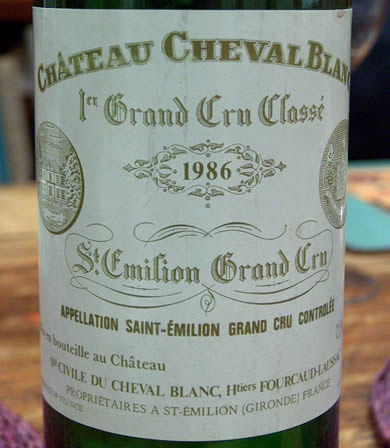 Château
Cheval Blanc 1986 Château
Cheval Blanc 1986
Beautifully perfumed nose: aromatic, with nice spicy,
smooth fruit and an elegant leafy edge. The palate is savoury and
elegant with lovely spicy structure. Really nicely poised.
Excellent 95/100
Petaluma
Merlot 1992 Coonawarra
Quite firm, rich and structured, but with a minerally
edge. Savoury and tight with good acid. A serious, tight-wound
savoury style of wine. Very good/excellent 90/100
Petaluma
1985 Botrytis Riesling Essence, Coonawarra
From a vineyard in Coonawarra that no longer exists.
This was 63% sugar when harvested, some three times the normal
level. It’s now 45% residual sugar, with 11 g/litre acidity and
9% alcohol. Deep orange/brown colour. Massively sweet and intense.
Slightly raisiny with lovely tangy lemony acid. Deliciously
intense.
Part
two will focus on a vertical
tasting of Petaluma wines, and then I'll report on the 2004
releases from Tapanappa, plus a lunch washed down with some old
Australian classics
See
also: A review (2010) of the
wines of Tapanappa
Wines tasted 09/05
Find
these wines with wine-searcher.com
Back
to top
|