|
The
New Barossa
Part 8:
Torbreck
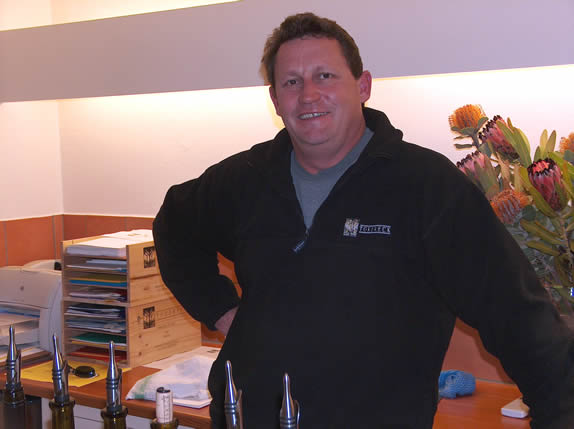
Dave Powell (pictured above) is a big bloke. I’ve heard
that he can lift a barrique above his head with ease. I get the
impression that he doesn’t suffer fools gladly – he takes plain
speaking to the level of bluntness, and it can actually be quite fun
to ask his opinion of someone you know he’s none too impressed
with. You don’t want to get on the wrong side of him, for sure.
But good on him – he spent an hour and a half with me talking me
through his wines, and then when we were in the pub on Saturday
night he found me again and bought me a Coopers Pale.
But let’s focus on his wines. Quite simply, they are
fantastic. For me Torbreck is the prototype ‘New Barossa’
winery. The only shame is the prices: they are expensive. The
Juveniles, for example, sells for £16 in the UK, and the Runrig is
well past £100 a pop. I have to concede, though, that these wines
are good enough to justify both the hype and the prices.
Dave started making his own wines in 1994. He studied
economics and entered the wine business by accident after working
the vintage at Yalumba in 1981. Subsequently he travelled widely and
worked lots of vintages, before starting work at Rockford in 1992.
He became aware of various old neglected vineyards in the Barossa,
and he started buying them up and making wine from them. His first
wines were sold to an English guy he’d worked with at Saltram,
Phil Reedman. His 94 Shiraz and 1995 Grenache went to Australian
Wine Agencies, and in 1997 the first Torbreck wines were released,
the 1995 Runrig and 1996 Steading.
 Powell
hasn’t looked back, and in 2004 Torbreck processed 1000 tons,
which is a significant quantity for a premium winery like this. Dan
Standish (right), who also makes his own wine (the Relic and
the Standish), and the Massena wines (in collaboration with Jaysen
Collins) is winemaker here. Powell
hasn’t looked back, and in 2004 Torbreck processed 1000 tons,
which is a significant quantity for a premium winery like this. Dan
Standish (right), who also makes his own wine (the Relic and
the Standish), and the Massena wines (in collaboration with Jaysen
Collins) is winemaker here.
Some notes on the names. Torbreck is the name of the
forest in Scotland where Dave Powell worked as a woodcutter.
Steading is the name of a pub in Edinburgh; also the term given to
outbuildings on a farm. Struie is a mountain he worked on in
Scotland; Factor is the guy who runs the woodcutting operation.
Descendant is descended from Runrig; it uses the old barrels from
Runrig and the vines were cuttings from the Runrig vines. And
Runrig? In one of the pubs Powell drunk in on Struie the band Runrig
played, and then the pub burnt down when they reopened. It’s also
the name of the land distribution system that evolved into the
crofting system.
Torbreck is primarily a red wine producer, but around
10% of the production is white. We began with the 2002
Woodcutter’s White, which is lovely and fresh with appealing
fruity character. It’s quite rounded, with some richness. Dave
Powell explains, ‘In the Barossa, the biggest problem is that
people have tried to make everything here. My idea is to work with
varieties that have not only been here a long time but also which
are suited to the climate’. The only non-Rhône variety they work
with is the Semillon used in this wine: the Madeira clone is used
which handles the heat well. Some old vine components are barrel
fermented; the younger grapes are fermented in stainless steel.
Next up, the Juveniles, which is an unoaked blend of
Grenache, Shiraz and Mataro, with the former dominant. ‘To me,
Grenache is the most exciting variety in the Barossa’, says
Powell. It is medium bodied, so it still has richness but it
doesn’t have the heavy tannins and syrupy fruit character. Powell
describes it as a ‘warm climate Pinot Noir’. The juice oxidises
easily, like Pinot Noir, and you have to watch the yields more than
with Cabernet and Shiraz. ‘You can’t be afraid of high alcohol
levels with Grenache’, he explains. ‘If you don’t get the
ripeness right it gives no richness’.
Torbreck Juveniles 2002
Average vine age 80+ years. Nose of lovely ripe, cherryish dark
fruits with some animally hints. Delicious vivid dark fruits on the
palate with some spiciness and a dark chocolate edge. A rich,
expressive style with lots of interest. Very good/excellent 92/100
Torbreck Juveniles 2003
Sweet, herby, spicy nose is very aromatic with some animally
depth. The palate has a lovely sweet, rounded character with very
expressive meaty, animally notes. Soft and quite delicious. Very
good/excellent 93/100
Torbreck The Steading 2002
The same wine as the Juveniles but given elevage in barrels.
Subtle, spicy, slightly minty edge to the nose. The palate is dark
and spicy with lots of fruit and some structure. Bold, full and
quite expressive. Very good/excellent 91/100
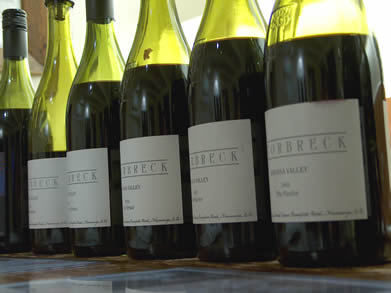 Torbreck
Woodcutter’s Shiraz 2003 Torbreck
Woodcutter’s Shiraz 2003
All the old vine vineyards have some younger vines in them, and
the grapes from these go into the Woodcutter’s. Average yields are
2 tons/acre and the wine is aged for 12 months in old foudres. Ripe,
smooth sweetness to the nose, which is quite aromatic. Lovely purity
of fruit on the palate with good intensity. Good acidity and quite
elegant. Very good/excellent 90/100
Torbreck The Struie 2002
A blend of Barossa and Eden Valley Shiraz, 20% new oak.
Breathtaking aromatic nose of pure red and black fruits. The
palate is ripe and full with lovely sweet, spicy fruit. Very elegant
with lovely spicy complexity and great purity of fruit. Some dark
chocolate hints. Excellent 95/100
Torbreck The Factor 2001
60–90 year old vines; 30% new oak; 18 hl/ha yields. Dark,
rich, chocolatey spicy nose. The palate is super concentrated with
bold, spicy, tarry fruit. Very rich and intense with some nice
toastiness from the oak and good acidity. Very classy in a big, bold
Barossa style. Super stuff. Very good/excellent 94/100
Torbreck The Factor 2002
Dark, sweet rich fruits on the nose. Lovely ripe, rich fruit on
the palate with nice structure. Good concentration of rich
blackcurranty fruit. Very appealing. Very good/excellent 92/100
Torbreck The Descendant 2002
This is from Shiraz vines planted in 94–95, harvested at 14
hl/ha. It is co-fermented with 8% Viognier, which when it is picked
is at 17 degrees Baumé. Pure, ripe elegant nose. The palate is
super-elegant with vivid, smooth fruit together with a lovely smooth
spicy structure. Brilliant purity of fruit: massive but elegant.
Excellent 96/100
Torbreck The Descendant 2003 (final blend)
Lovely structure: a big wine but with great purity of fruit.
Silky tannins. 92–95/100
Torbreck Runrig 2001
Old vineyards harvested at an average of 12 hl/ha. A little bit
of Viognier is included. It spends 2.5 years in wood, all French,
60% new. Pure spicy nose with sweet, spicy, chocolatey notes. The
palate is elegant and spicy. Quite rich with lots of complexity,
smooth silky tannins and great length. A big wine but not at all
overdone. Very expressive. Very good/excellent 94/100
Torbreck Runrig 2002 (base, without the Viognier)
Great concentration: rich and bold with lots of fruit, and spicy
tarry complexity. Very dense with rich fruit.
Torbreck Les Amis 2002
This is a varietal Grenache that sells for the same sort of
price as Runrig. 2002 is the second vintage; the first was 2001.
It’s from a single vineyard planted in 1901, harvested at 12
hl/ha, and aged for 18 months in new barrels. A dark, rich wine.
Slightly shy and taut nose with a spicy edge. Massive concentration
of sweet, spicy fruit on the palate which is very intense. Lovely
earthy spiciness. Smooth, silky tannins: bold and extremely long.
Excellent 96/100
The Bothie 2003
A sweet wine from Muscat à Petit Grains Blanc. Pretty, grapey,
refined nose. Very fresh and grapey on the palate. Good acid and
soft texture with nice balance. Very good+ 88/100
Part 14: Teusner
Part
15: Troy Kalleske
Part
16: Clancy Fuller
Part
17: Domenic Torzi, revisited
Part
18: Rusden
Part
19: Kym Teusner, revisited
Part
20: Veritas, revisited
Part
21: Greg Hobbs, revisited
Part
22: Massena vertical
Back
to top
|