|
The
Clare Valley
Part 4:
Wendouree
This article is in two parts: first, a report on a
visit in 2005, and second, the notes from a tasting
of Wendouree wines held in May 2006.
I’d finished tasting at Mitchell, and Andrew
generously asked me if there was anyone else in Clare that I’d
like to see. I tentatively suggested Tony Brady at Wendouree, and a
phone call later I had an appointment with the man himself.
Wendouree is one of the cult legends of Australian wine, but until
the day before, I’d never tasted the wines before because it’s
just about impossible to get hold of them. My first Wendouree wine
was with Andrew the previous night: the 1984 Ruby Port, which sadly
was slightly corked. Still, behind the taint was a serious
Port-style wine.
 I turned up exactly on time and made my introduction.
It’s immediately clear that Tony Brady isn’t some Hollywood
caricature of a winemaker. He’s his own man, and he’s the sort
of person that takes his time forming an opinion of who it is he’s
dealing with. I like that. We take things slowly. Let’s face it,
Tony has no need of positive write-ups from journalists. If
anything, it could only make his life harder. I turned up exactly on time and made my introduction.
It’s immediately clear that Tony Brady isn’t some Hollywood
caricature of a winemaker. He’s his own man, and he’s the sort
of person that takes his time forming an opinion of who it is he’s
dealing with. I like that. We take things slowly. Let’s face it,
Tony has no need of positive write-ups from journalists. If
anything, it could only make his life harder.
Why? Well, he has an enviable set-up as winemakers go.
He makes a limited amount of wine, and demand so far exceeds supply
that his biggest problem is how to allocate it. More of that later.
‘What would you like to do?’ he asks me. See the vineyards is my
stock response when I’m asked this question, because you can tell
a lot from seeing where the grapes come from.
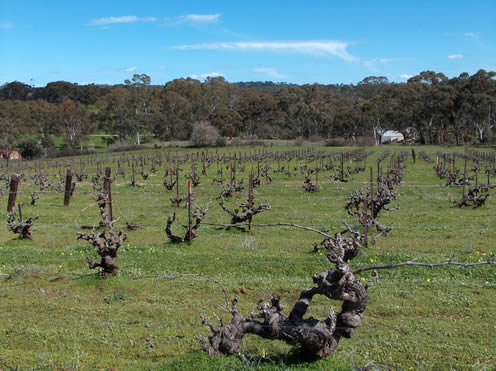
AP Birks Wendouree Cellars (to use the full name) is
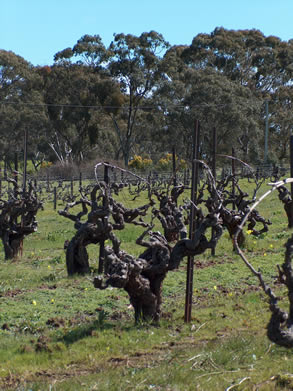
one of the historic properties of the Clare. Vines were first
planted here in 1892, and they are still going. The vineyards are
stunning, with some wonderful old vines. Tony brought the property
in 1974, but had no experience of winemaking. Fortunately, there was
a chap who had started working there in 1917 who stayed on for seven
years, showing Tony the ropes. In the meantime, Tony’s wife did a
wine science degree at Wagga. He admits that he got into winemaking
by chance. Interestingly, he lived in London in the height of the
1960s, and even went to the Isle of Wight Festival in 1969. Two
weeks after Woodstock, this was the last time that Jimi Hendrix
played. Cool.
While we were wandering through the vines I asked Tony
whether I could take his picture. I always ask before I shoot, out
of politeness, but as a sort of formality. He declined. I thought he
was joking, so I asked again. He declined again, a bit more firmly.
Why? ‘There’s too much peddling of winemakers,’ he said. ‘They
get a false view of their role in the scheme of things.’
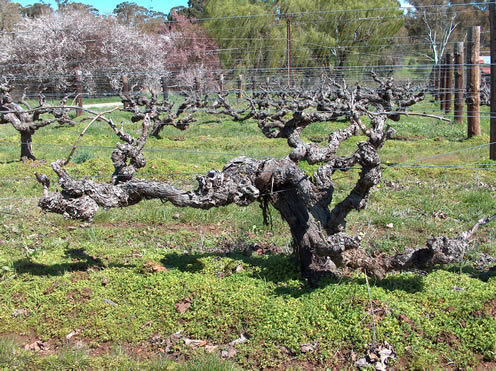
Altogether Wendouree has 28 acres of vines, all dry
grown, yielding around 50 tons per vintage. The grapes aren’t
picked super ripe, but at around 13.5 degrees alcohol. Ripeness is
staggered between different parts of the vineyard, which is an
advantage because hand picking is employed. Herbicides are eschewed,
as is turning the ground, saving around the equivalent of an inch of
rain a season. The vigour is controlled by the old vines.
Back in the cellar, we discussed his mailing list. I
saw the sacred box file, containing Tony’s customer list. This is
the way he sells his wine: regulars get 6 of each, should they
request them. There are no short cuts: if the list is full, you have
to wait your turn, no matter who you are. I get the impression that
deciding who to sell wine to is a task that Tony doesn’t dislike.
If a senator phones up and tries to sweet-talk him, this doesn’t
get them any more wine. Indeed, while we were in conversation, there
are two or three phone calls from mailing list customers anxious
about their forthcoming allocation. He needs to police his list
because the retail price charged is significantly less that the
price these wines attract on the secondary market.
 Time for some coffee, which Tony hand grinds in a
lovely old brass grinder. He’s in no hurry to show me his wines. I
begin to wonder if tasting is even on the agenda. This is a highly
unusual, yet strangely refreshing visit. Time for some coffee, which Tony hand grinds in a
lovely old brass grinder. He’s in no hurry to show me his wines. I
begin to wonder if tasting is even on the agenda. This is a highly
unusual, yet strangely refreshing visit.
What about technology in the cellar? ‘The significant
thing is the method’, says Tony, emphasizing that it is not the
tools that matter as much as the way they are used. ‘The critical
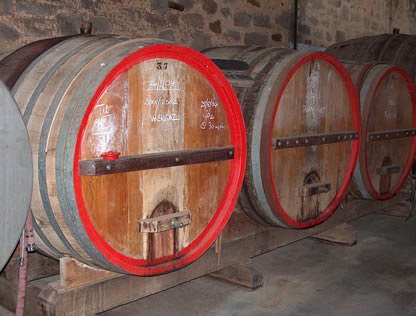
technology in winemaking is the method’. He uses open top
fermenters, which are quite small – a bit like lagares. These open
fermenters can blow off about a degree of alcohol, which is one
advantage with their use.
At last, a wine. It’s 2004 Cabernet, from tank and
prior to malolactic. A deep red purple colour this has a nose of
sweet, intense blackcurrant fruit. It’s primary and taut with a
minerally spiciness. The palate shows good concentration, high
acidity and firm tannins. These are fine grained. It’s an elegant
wine with lots of structure, in a lean, ageworthy style. This will
go into a mixture of new and old barrels, all French.
Tony says he is in the business of making wines for
longer maturation. If you finish fermentation in wood the wine looks
good young but it’s not good for the long term. Malolactic is
important and needs to be controlled, hence he does it in tank, not
barrel.
The visit draws to a close with the tasting of a second
wine. It’s the 2004 Muscat from tank, which is pretty and grapey
with an aromatic floral nose. Lovely richness and viscosity on the
palate; sweet and full. A vin
doux naturel. I leave, mentally logging that I must track down
some Wendouree wines with a bit of bottle age. My appetite has been
wetted.
The
tasting, a year later...
After
visiting Wendouree in 2005 and trying a solitary cask sample, I was
delighted to be able to try a decent selection of the wines at a
tasting organized by David Thomas at his shop, The Cellar Door (www.thecellardoor.co.uk),
in Overton, Hampshire.
I have to be honest: these are my sort of wines. Unusual for modern
Australian reds, they’re not terribly alcoholic. They are wines
for the long haul, and sacrifice some early drinkability and
seductive deliciousness for some future development—a wise
investment. I can’t think of a more consistently excellent
Australian producer.
Wendouree
Cabernet Malbec 2002 Clare Valley
Lovely tight dusty, spicy nose of pure red fruits. It’s quite
smooth and elegant with a lovely freshness to the fruit. The palate
is structured and tight with firm acid and good tannic structure.
Very primary. There’s a lovely concentration here: it’s quite
austere but brilliantly structured, tending to red fruits rather
than black. Needs 20 years. Excellent 96/100
Wendouree
Shiraz Malbec 2000 Clare Valley
Initially a tight, rather closed nose with a hint of spice and
smooth tannins. There’s a touch of meatiness, too, although the
dominant feature is sweet pure red and black fruit. The palate shows
some rich, tarry, spicy red and black fruits with massive spicy
structure and good acidity. Nice balance here: a bit richer than the
previous wine. Very good/excellent 93/100
Wendouree Shiraz Mataro 2000 Clare Valley
Quite a tight spicy nose showing some plump, plummy fruit with a
bit of chocolatey richness. The palate combines ripe, sweet fruit
with a firm spicy structure. Brilliantly structured and has a nice
future ahead of it. Very good/excellent 93/100
Wendouree Shiraz 2000 Clare Valley
Another dark, spicy, tight nose. The palate shows fantastic
concentration and lovely freshness to the bold ripe fruit but with
wonderful spicy structure and acidity. This is a massive wine with
huge potential. Excellent 96/100
Wendouree Shiraz Mataro 1995 Clare Valley
Lovely precise nose: slightly lifted with some spice and fresh
crunchy red fruits. Quite complex. The palate is opening out a bit
with nice complexity and the tannins are still firm. Nice acidity
keeps it tasting youthful; this is a nice, structured, fresh wine.
Very good/excellent 94/100
Wendouree Shiraz 1990 Clare Valley
There’s a nice earthiness emerging under the smooth, focused,
almost liqueur-like fruit. The palate is beautiful: the structure
has softened a bit to reveal pure, subtly spicy red fruits. Focused
and brilliant. Excellent 95/100
wines
tasted 06/06
And
an extensive vertical tasting in November 2010 is now
published here
Back
to top
|