|
Yarra
Valley, part 2
The wines
of Yeringberg

Guill
de Pury, Yeringberg
After visiting Domaine Chandon, my next appointment in
the Yarra was something completely different. Yeringberg is as
about as far from a hi-tech glitzy modern winery as you could get,
but it is a place full of history and charm, and the wines have a
loyal following.
Guill de Pury (pictured above) is a third-generation
winegrower, and is responsible for resurrecting Yeringberg as a
wine estate in the 1970s; indeed, this was the beginning of the
Yarra renaissance—after a 50 year period when winegrowing had
disappeared from the valley.
Yeringberg was one of the pioneering winegrowing
properties when wine first came to the Yarra in the mid-19th
century. His grandfather, Frederic Guillame de Pury, who was a
Swiss baron, came here in 1863, after he’d been in Australia for
a decade, and bought part of the original 43 000 acre Yering
Station, which itself had been established in 1837. In the 1860s,
this original Yering Station was split into three poperties (Yeringberg,
St Huberts and Yering). But winegrowing in the Yarra suffered a
downturn in fortunes, and the last big vineyards were pulled out
in 1921. This was because Australia largely lost interest in table
wines, opting for fortifieds and beer instead, coupled with the
depression. Most of the vineyards were abandoned and the
properties maintained for grazing. Yeringberg itself is to this
day predominantly a 1200 acre sheep and cattle farm, with 2000
sheep and 250 cows.
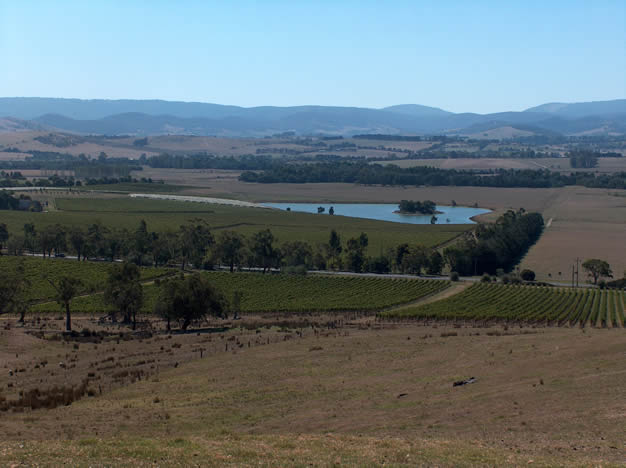
The vineyards
‘When Guill and I first married there had been no
wine here for years and years’, recalls Guill’s wife
Katharine. ‘We used to meet elderly people who remembered Guill’s
father’s white.’ Guill started replanting the first vines in
1969, making the first of the new generation of Yeringberg wines
in 1974. Until recently there were just 5–6 acres of vines here;
now there are 50 (the original vineyard area was 80 acres), which
produces about 20 tons (but presumably will produce more as the
new vineyards come on line). Five wines are made.
Guill has a PhD in biochemistry, which he obtained in
the 1960s. His son also has a PhD, this time in plant physiology.
He remarks that there are now about 3500 hectares of vines in the
Yarra Valley, up from 2000 hectares 20 years ago, with many of the
newer plantings in unsatisfactory places, with quite a few in
frost hollows. Regarding the longevity of Yeringberg wines, Guill
recalls the story of the 1915, tasted by no less an authority than
Hugh Johnson, which Guill had purchased back off a collector in
Tasmania. Apparently it was showing well. He holds vertical
tastings, and maintains that the 1976, enjoyed recently, was very
impressive.
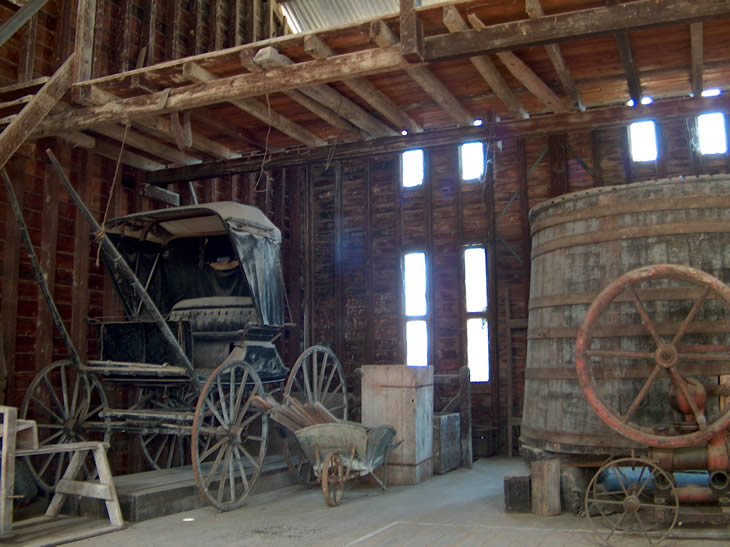
Inside the winery
Yeringberg Marsanne Roussanne 2004
The two varieties are picked separately because they ripen at
different times. This has a fresh bright nose that’s citrussy
and quite perfumed. The palate shows some richness of texture: it’s
fruity, with a hint of melon and some lemony freshness. Some
interest here. Very good+ 88/100
Yeringberg Chardonnay 2005
Starts off in tank but does most of its fermentation in wood,
after the gross lees have dropped out. There’s some bentonite
fining during the fermentation process to assist this. It has a
rounded, ripe, nutty nose with some vanilla sweetness. The palate
has some woody notes and nice nutty fruit. Quite fresh and
rounded. It’s understated: not a big wine, but one with a nice
personality. Very good+ 89/100
Yeringberg 2003
A blend of Cabernet Sauvignon, Cabernet Franc, Merlot and
Malbec. Sweet, pure dark fruits nose with a spicy, earthy edge.
There’s some chocolatey richness too. The palate shows supple
red berry and blackcurrant fruit with nice acid and an understated
spicy, chocolatey structure. According to Guill, this wine will
probably go a bit flat and lose fruit, but then after 8 years will
start to look like a mature wine: classic and nicely structured.
It’s delicious with lots of potential. Very good/excellent
92/100
Yeringbery 1994
Lovely rounded blackcurrant nose with some subtle green herbal
elements. The palate is structured with a lovely savouriness and
earthy, herb-tinged blackcurrant fruit. Still very fruity, with
some earthy structure. Still quite youthful and has potential for
further development. Very good/excellent 92/100
Yeringberg Shiraz 2003
From young vines (3 years old at this stage). Fresh, bright,
almost minty berry fruits nose. The palate shows bright peppery
fruit. Juicy and bright, with nice fruit.
see
more pictures from Yeringberg here
Yarra series:
Wines tasted 03/06
Find
these wines with wine-searcher.com
Back
to top
|