|
Yarra
Valley, part 1
The wines
of Tony
Jordan at Domaine
Chandon/Green Point, Yarra Valley, Australia
'Green
Point', Maroondah Hwy, Coldstream, VIC
3770
Tel:
03 9738 9200 Fax :
03 9738 9241
E-mail : cellardoor@domainechandon.com.au
Website:
http://www.greenpointwines.com.au
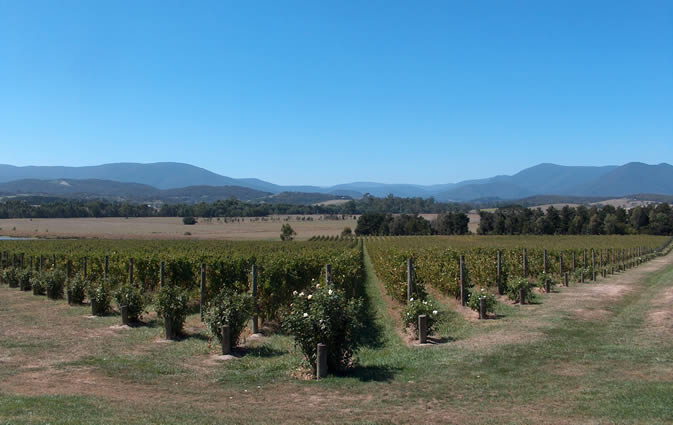
The
view from Chandon's restuarant and tasting room
Dr
Tony Jordan is currently Chief Executive Officer of three of the
big names in Australian/New Zealand wine: Cape Mentelle (Western
Australia), Cloudy Bay (Marlborough, NZ) and Domaine Chandon (in
the Yarra Valley, which he established for Moët et Chandon in
1986). In March 2006 he kindly hosted me for a few days as I
explored the Yarra.
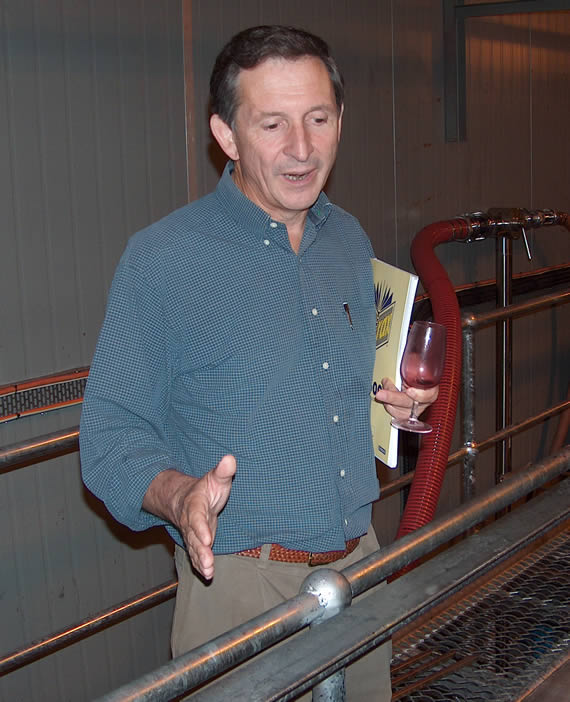 Tony
(pictured right) completed a PhD at Sydney University in
Chemical Physics. He is officially a smart guy. This was then
followed with 18 months working as a postdoctoral researcher at
University College, London. The funding for this position dried up
so he returned back to Australia, where he took a job as a patent
attorney in Sydney. ‘It was an interesting era’, he recalls,
‘because there were zero people with high technical
qualifications in the industry’. However, Tony hated sitting in
a Pitt Street office. ‘I was looking at the job ads in
universities, and one came up at Riverina College (now Charles
Sturt Univesity)—a lectureship for Physical Chemistry and Wine
Science’. Tony describes himself as a ‘wine nutter’ at the
time—this was in 1974—and so he applied for, and landed, the
job. The course of his life had changed. Tony
(pictured right) completed a PhD at Sydney University in
Chemical Physics. He is officially a smart guy. This was then
followed with 18 months working as a postdoctoral researcher at
University College, London. The funding for this position dried up
so he returned back to Australia, where he took a job as a patent
attorney in Sydney. ‘It was an interesting era’, he recalls,
‘because there were zero people with high technical
qualifications in the industry’. However, Tony hated sitting in
a Pitt Street office. ‘I was looking at the job ads in
universities, and one came up at Riverina College (now Charles
Sturt Univesity)—a lectureship for Physical Chemistry and Wine
Science’. Tony describes himself as a ‘wine nutter’ at the
time—this was in 1974—and so he applied for, and landed, the
job. The course of his life had changed.
Once
he arrived at Riverina College, Tony developed a course for
oenology together with Don Lester (now viticultural director at
Pernod Ricard Orlando), because there was a pent up need in
Australia for people who’d got into the wine industry to get
some science. But Tony admits that ‘our students knew more than
we did’. So one of their first moves was to get an experienced
lecturer in oenology, and so Hardy’s Chied Winemaker, a Mr Brian
Croser, was hired. Tony recalls that Croser was ‘going somewhere’,
and that this was the next step for him.
One
of the new ways of thinking that emerged from Riverina at this
time was that the vineyards produce fruit flavour, and the
winemaking should aim to capture this flavour. At the time
winemakers just thought, ‘there’s a vineyard out there that
grows grapes’, and the predominant form of vineyard management
was mushroom flop viticulture (where the canopy grows unsupported
on a single wire, descending either side under its own weight).
The next 10 years led to some huge changes in what went on in
Australian viticulture and winemaking.
In
1977 Tony took off for a sabbatical with Helmut Becker at
Geisenheim. Becker put Tony through all the research institutes
and best wineries. ‘He did me a huge favour’. On his return,
he found out that Croser was leaving. He’d been developing
Petaluma (first vintage 1976) and had found the money through his
network of associates (including Len Evans and Peter Fox) to
strike out on his own. Jordan carried on lecturing oenology, but
then in 1978, together with Brian, Tony formed a consulting
company called Oenotech.
For
the first year, there was no income and just one client. But then
things took off, and Tony spent the next decade consulting widely.
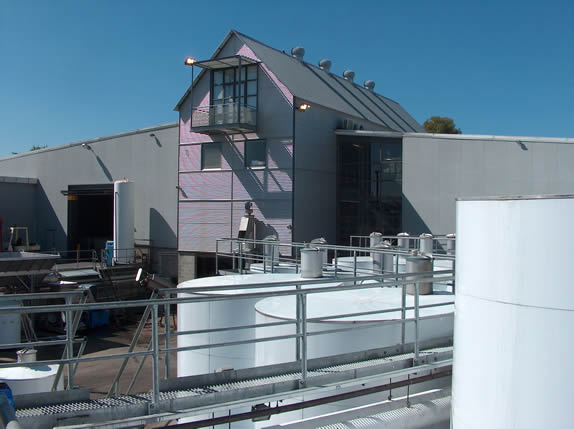
The
winery at Chandon
Chandon
came along in 1986, when Tony was approached by Moët, via James
Halliday. His Oenotech partner Croser wasn’t able to work for
Moët Hennessy, however, because one of Petaluma’s backers was
Bollinger, a competitor. Tony began working for Moët as MD of
Domaine Chandon in 1987/88. With the exception of a brief, rather
ill-fated spell with Wirra Wirra, he’s been there since, and was
made CEO of Cape Mentelle, Domaine Chandon and Cloudy Bay in 2003.
Sparkling
wine is the focus of Chandon, but they also make some very smart
still wines.
The site for Chandon is in the middle of the original Yarra
viticultural area of the 1850s. Tony Jordan looked at lots of
areas for Moët to establish their operation in, but in the end
they chose the Yarra. Jordan’s experience is that the Yarra has
more diverse terroirs than expected across the valley. There’s a
month’s difference in ripening from one end of the valley to the
other.
 For
sparkling wines Jordan is looking for grapes which when tasted
have just lost their greenness and have the first onset of
fruitiness. It’s not good enough simply to pick grapes really
early in order to get the high acidity, because then you’ll have
greenness. The grapes need to reach a point of physiological
ripeness that occurs alongside high acidity. So far just 2000 has
been a non-vintage year: this was because it was a warm year and
there was too much fruit flavour. For
sparkling wines Jordan is looking for grapes which when tasted
have just lost their greenness and have the first onset of
fruitiness. It’s not good enough simply to pick grapes really
early in order to get the high acidity, because then you’ll have
greenness. The grapes need to reach a point of physiological
ripeness that occurs alongside high acidity. So far just 2000 has
been a non-vintage year: this was because it was a warm year and
there was too much fruit flavour.
Jordan
is looking for ‘reminders’ of Champagne in terms of flavour,
particularly in the structural sense, working at a low level of
ripeness. At the edge of ‘no longer green’, when the grapes
are picked, he finds large differences in flavour development
between the warmer sites on the valley floor, and the Strathbogie
vineyards at 600 metres. The cooler sites tend to give more
desirable base wines. ‘If you get your picking right, you can
make ultrapremium sparkling wines’, says Jordan. He picks at
10.5–11.5 Baume. In Australia, they are not allowed to
chaptalize: the only legal point for addition of sugar is at
tirage.
Go
to part 2,
the wines
Yarra series:
Wines tasted 03/06
Find
these wines with wine-searcher.com
Back
to top
|