












|
Mechanisms
of terroir As more new world producers start to take an interest in terroir, scientists are turning their attention to defining it and explaining how it affects a wine. Jamie Goode investigates. (This feature was originally published in Harpers Weekly, September 12th 2003)
Even fairly recently, the new
world response to ‘terroir’ was that it was a last ditch
marketing ploy by European winegrowers who were panicking about
their increasing loss of market share. This turn-around is because
new world wine growers have realized that one of the keys to wine
quality is starting with grapes that show homogeneous (even)
levels of ripeness, and the recognition of the role that natural
variation within and between their vineyards plays. With the
increasing adoption of technique known as precision viticulture,
vineyards are commonly broken up into sub-plots sharing similar
characteristics (known as natural or basic terroir units) so that
vineyard interventions can be precisely targeted to where they are
needed. But you don’t have to look too far below the surface to
see that there are subtle but important differences between old
world and new world notions of terroir. Speaking generally, in the
old world terroirists aim to make wines that express the typicity
of the specific vineyard site, whereas in the more pragmatic new
world, understanding terroir is seen as a route to improved
quality. A
taste of the soil? Correspondingly, many old world growers feel they have a duty to make wines faithful to the vineyard sites they are working with. These growers will commonly make associations between properties of the wines and the soil types the grapes are grown on. In some cases these putative associations are quite specific: people will talk about mineral characters in wines and associate them with the minerals in the vineyard, taken up by the roots of the vines. There’s even a French expression, goût de terroir, that is used to describe this. Do chalk, flint or slate soils impart chalky, flinty or slate-like characters to wine? As a scientist who has a working knowledge of plant physiology, I find this notion, which I call the ‘literalist’ theory of terroir, implausible. Yet I can’t get away from the fact that an overwhelming majority of the world’s most compelling and complex wines are made by people who hold the notion of terroir as being critical to wine quality. Thus the goal of this feature is
to explore the mechanisms of terroir, focusing specifically on
soils. Just how do soils affect wine quality? Is it a direct or
indirect relationship? What are the scientific explanations for
terroir effects? Randall’s
Rocks ‘Our experiments were incredibly simplistic and gross in comparison to the very subtle chemistry that occurs in mineral extraction in real soils,’ explains Grahm. ‘We simply took interesting rocks, washed them very well, smashed them up and immersed them in a barrel of wine for a certain period of time, until we felt that the wine had extracted some interesting flavours and we were able to discern significant differences between the various types.’ Surely, this is taking the literalist notion of terroir – that flavour compounds are translocated from the soil to the developing grapes through the vine roots – to its extreme. Grahm continues, ‘We initially screened a number of different rocks with bench trials and ultimate decided on a few for larger scale experimentation - rip rap (granite), Noyo cobble stone, black slate and Pami pebbles. We certainly took the extraction way too far as we ended up seeing pH rises of 0.5–0.7 units, i.e. from 3.5 to 4.1 or 4.2, which is clearly beyond the pale for most wines. Obviously the big pH shift and the lowering of the acidity caused major changes in the texture and mouthfeel of the wine, but we also observed dramatic differences in aromatics, length and persistence of flavour.’ Grahm is convinced of the importance of mineral flavours in wine. ‘In every case, low doses of minerals (before we really overdid it), added far more complexity and greater persistence on the palate.’ His view is that minerality in wines has important implications for wine quality. ‘It is my personal belief that wines that are richer in minerals just present way differently. I believe that in general mineral-rich wines there is a suppression of obvious fruit. What is most striking to me though about wines that have higher levels of minerals is that they seem to have a certain sort of nucleus or density around their centre, they are gathered, focused, cohered the way a laser coheres light. It is a different kind of density relative to tannic density, somehow deeper in the wine than the tannins. In any event, I am utterly convinced that minerality is the one true key to ageability in wines and that everything else—tannin, acidity, sulphur dioxide—plays a far more secondary role.’ It is unlikely that adding rocks
to wines will ever become a common winemaking manipulation,
though. Grahm’s rock-infused wines ran into some trouble with
the regulatory body in California who were finding elevated levels
of nickel and antimony, among other things, so it looks like this
experiment won’t be repeated. Scientific
views of terroir Dawid Saayman, a South African viticultural expert known for his work on terroir, adds that, ‘I don’t believe that the minerals taken up by the vine can register as minerality in the wines. Minerality appears to me to be more the result of absence of fruitiness.’ But it’s pretty much a given that wines that made from grapes differing only in the soil in which they were grown taste different. So just what is the scientific
explanation for these terroir effects? It is an important
question, because providing a sound scientific footing for terroir
is a worthy cause. Not only will it lend credibility to the
concept in the eyes of sceptics, but it will also help the already
converted understand and therefore better utlilize terroir
effects. If we are going to frame terroir in scientific language, then we’ll need to start with some plant physiology. The miracle of the plant kingdom is that these complex organisms build themselves from virtually nothing: all a plant needs to grow is some water, sunlight, air and a mix of trace elements and nutrients. All the complex structure and chemistry of an oak tree, a daffodil or a grapevine is fashioned from these very basic starting ingredients. What do vine roots take up from the soil? Primarily water, along with dissolved mineral ions. It seems implausible that such a complex structure as a vine is created from virtually nothing by photosynthesis – the capture of light by specialized organelles called chloroplasts, which turn light energy into chemical energy that the plant can use—but that’s the way it is. As Richard Smart emphasizes, ‘All flavour compounds are synthesized in the vine, made from organic molecules derived from photosynthesis ultimately, and inorganic ions taken up from the soil.’ Professor Jean-Claude Davidian
of the Ecole Nationale Supérieure Agronomique in Montpellier,
echoes these sentiments. ‘Nobody has been objectively able to
show any links between the soil mineral composition and the
flavour or fragrance of the wines’, he says. Davidian adds that
‘those who claim to have shown these links are not
scientifically reliable’. |
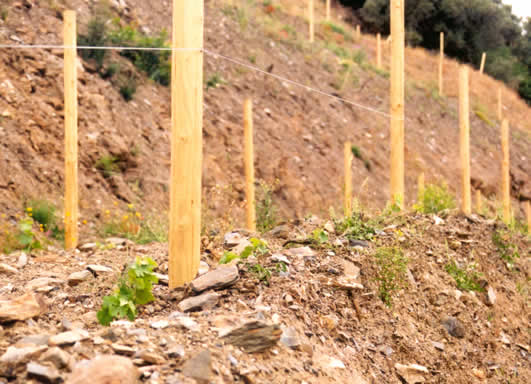 ‘Terroir’
is currently an in vogue concept. Once almost exclusively the
preserve of the old world, it’s now a talking point in the new
world, too. The traditional, old world definition of terroir is
quite a tricky one to tie down, but it can probably best be
summed-up as the possession by a wine of a sense of place, or
‘somewhereness’. That is, a wine from a particular patch of
ground expresses characteristics related to the physical
environment in which the grapes are grown. But why the sea-change
in the new world, where for so longer the job of grape growing was
seen merely as a mundane prelude to the work of the all powerful
winemaker?
‘Terroir’
is currently an in vogue concept. Once almost exclusively the
preserve of the old world, it’s now a talking point in the new
world, too. The traditional, old world definition of terroir is
quite a tricky one to tie down, but it can probably best be
summed-up as the possession by a wine of a sense of place, or
‘somewhereness’. That is, a wine from a particular patch of
ground expresses characteristics related to the physical
environment in which the grapes are grown. But why the sea-change
in the new world, where for so longer the job of grape growing was
seen merely as a mundane prelude to the work of the all powerful
winemaker?