|
The
Christian Seely interview
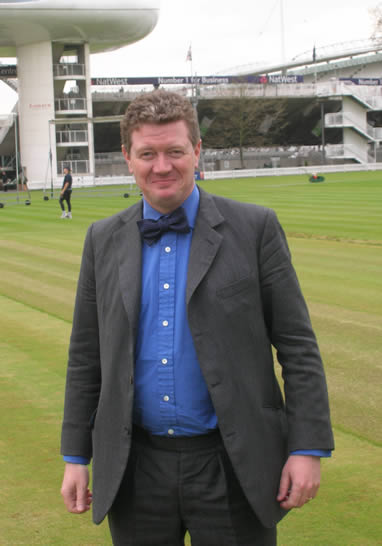 Bow-tied
40-something Christian Seely is a very important dude. After the
wine arm of French insurance group AXA purchased Quinta do Noval
in the Douro, in 1993, it was Christian’s job to revitalize it.
He spent seven years in the Douro, and did a great job. He was
rewarded by being given charge of all of AXA-Millésimes
properties on the retirement of Jean-Michel Cazes in 2000, which
as well as Noval include Pichon-Baron, Petit Village and Suduiraut
in Bordeaux, Belles Eaux in the Languedoc, as well as Disznókó
in Hungary. I caught up with him in London before the Bibendum
Bordeaux 2005 en primeur
tastings in April 2006. Bow-tied
40-something Christian Seely is a very important dude. After the
wine arm of French insurance group AXA purchased Quinta do Noval
in the Douro, in 1993, it was Christian’s job to revitalize it.
He spent seven years in the Douro, and did a great job. He was
rewarded by being given charge of all of AXA-Millésimes
properties on the retirement of Jean-Michel Cazes in 2000, which
as well as Noval include Pichon-Baron, Petit Village and Suduiraut
in Bordeaux, Belles Eaux in the Languedoc, as well as Disznókó
in Hungary. I caught up with him in London before the Bibendum
Bordeaux 2005 en primeur
tastings in April 2006.
Natural
wine
I kicked off by asking him what he thought of the
concept of ‘natural wine’: is it meaningful or important?
‘You can’t make wine great by technological means alone’,
was his response. ‘The properties I look after all have one
thing in common: they have great vineyards and terroir: this is
what creates great wines’.
Seely gave the example of Pichon-Baron. ‘It has 70
hectares, but 40 hectares of these are the ones that make the
great wine.’ He explained that they do everything the same for
all 70 hectares, and the winemaking is the same, but continually,
year after year, the greatest wine comes from the greatest
terroir. ‘If technology alone were enough, then this shouldn’t
be so’, maintains Seely. ‘There’s something special about
the “place” that gives the wine the character, and we have to
be humble in the face of that’. There are limits to what
technology and winemaking can achieve.
Traditional
versus modern Bordeaux
I quizzed Seely on stylistic issues in Bordeaux. What did he think
about the new wave ‘international’-style wines that the
traditionalists are so alarmed about? Is it possible to make a
fake or dishonest wine by aiming for super-ripeness from low
yields and then pushing the wine in the winery? ‘I wouldn’t
say that a wine like that isn’t honest’, was his response,
‘At the end of a year wine is a result of many things, including
the decisions people have taken—their idea of what they should
be doing in the vineyards’. I suggest to Seely that he’s a bit
of a libertarian at heart, and he doesn’t disagree. ‘They [the
wineries making modern-styled wines] are doing their best to make
the greatest wine they can, and as consumers you can choose
whether to buy them or not. Those techniques require lots of
expense and they aren’t done out of laziness’. Seely adds,
‘It’s too easy to condemn what someone else does: the
fascinating thing is the extreme diversity of wine.’
Seely won’t be drawn into discussions about
particularly controversial Bordeaux wines. ‘There are wines that
polarize opinion, but I find it rather interesting’, he
comments. ‘If a wine excites extreme disagreement among those
who taste it, then why not?’ In true libertarian fashion, Seely
leaves it all up to the individual. ‘It’s up to the person who
buys the bottle to decide, and to decide which critic to agree
with. The wonderful thing about wine is that it inspires passion:
the worst thing would be if people were indifferent.’
Closures
I apologise for raising
the subject of closures, an important but potentially boring
topic. ‘I wouldn’t be ready to change the closure on Pichon
Baron, Noval or Suduiraut, which are wines made to be aged over a long
time’, maintains Seely. He reckons that it’s too soon to make
these decisions, and more time is needed for trials. These trials
are underway, and bottles of Pichon have been sealed with various
alternative closures: the idea is to leave them for 10–15 years
to see how they do. ‘Personally, I’m quite attached to the
romance of the cork, but as a significant consumer of wine I have
disappointments at home. It’s upsetting.’
2005
Bordeaux
Seely admits that en primeur
time isn’t a comfortable one. ‘It’s a terrifying time:
it’s not just that year’s work that is under examination,
it’s the quality levels of the Château that are the result of
cumulative extraordinary hard work. When you put a vintage into
bottle it is not just that year that is being judged, but
everything you have done.’ But 2005 seems to be pretty well
received. ‘I think it’s a great and outstanding vintage. In
fact, from 2000–2005 we have had a series of wonderful
vintages’, adds Seely. 2001, 2002 and 2004 haven’t attracted
hype, but 2000, 2003 and 2005 have. ‘2004 is a year that no one
is really excited about, but it is also a beautiful, great
vintage’. What about critics? ‘There are three or four who are
more important than most, but usually with a vintage there is a
cumulative weight of journalistic opinion: you can see quite soon
how the wind is blowing.’ But he adds that, ‘the most
important thing is that people who buy the wines and drink them
will have their own opinions in the end.’
Has Bordeaux changed much in recent decades? ‘Very
much’, says Seely. ‘The technology hasn’t changed much, but
the way people work in the vineyards has. ‘Most of the great
properties are stricter with themselves than they used to be,
eliminating grapes that aren’t perfect. The final selection of
the grand vin is also much stricter.’ He gives some examples.
Pichon Baron in the 1990s produced 300–380 000 bottles each
year; Since 2000 it has been 200–270 000 bottles.
‘The reason for this is that it is worth our while to
do it’, says Seely. ‘The market rewards excellence, and there
is a corresponding increase in demand and price when you make a
great wine.’
Noval
I asked Seely whether he had any plans to make a table
wine from Quinta do Noval. The answer is that one is soon to be
released. ‘We have made one in the past, but not from the best
grapes. We replanted lots of Noval’s vineyards in the period
1994–6, and now we are starting to have Touriga Nacional,
Touriga Franca and Tinta Cao in quantities to be able to start
experimenting. In 2004 we came up with a wine worthy to bear the
Noval name.’ 1000 cases will be produced. I mentioned to Seely
that I’d been hugely impressed with the 2003 vintage Port from
Noval. What was the secret? ‘It is the cumulative work that has
taken place here since 1993’, he reports. Two things have
changed: ‘We have been applying the same ruthlessness in the
vineyard with respect to fruit that we do in Bordeaux: we reject
shrivelled grapes and those with rot’. But this trie in the
vineyard is not east to achieve: the pickers have a problem with
wasting grapes. ‘It is difficult to get people to change their
techniques, so we do a preliminary trie in the vineyard, picking
out the rubbish fruit’, says Seely. The second change has been
to replant much of the vineyard. Noval has 66 hectares, and 35 of
these were replanted in the first three years, all with Touriga
Nacional, Tinta Roriz, Tinta Cao, a bit of Tinta Barocca and a bit
of Touriga Francesa. These 1994/5 replantings were in the 2003
Vintage Port.
See
also: Visiting Quinta do Noval
Back
to top
|